
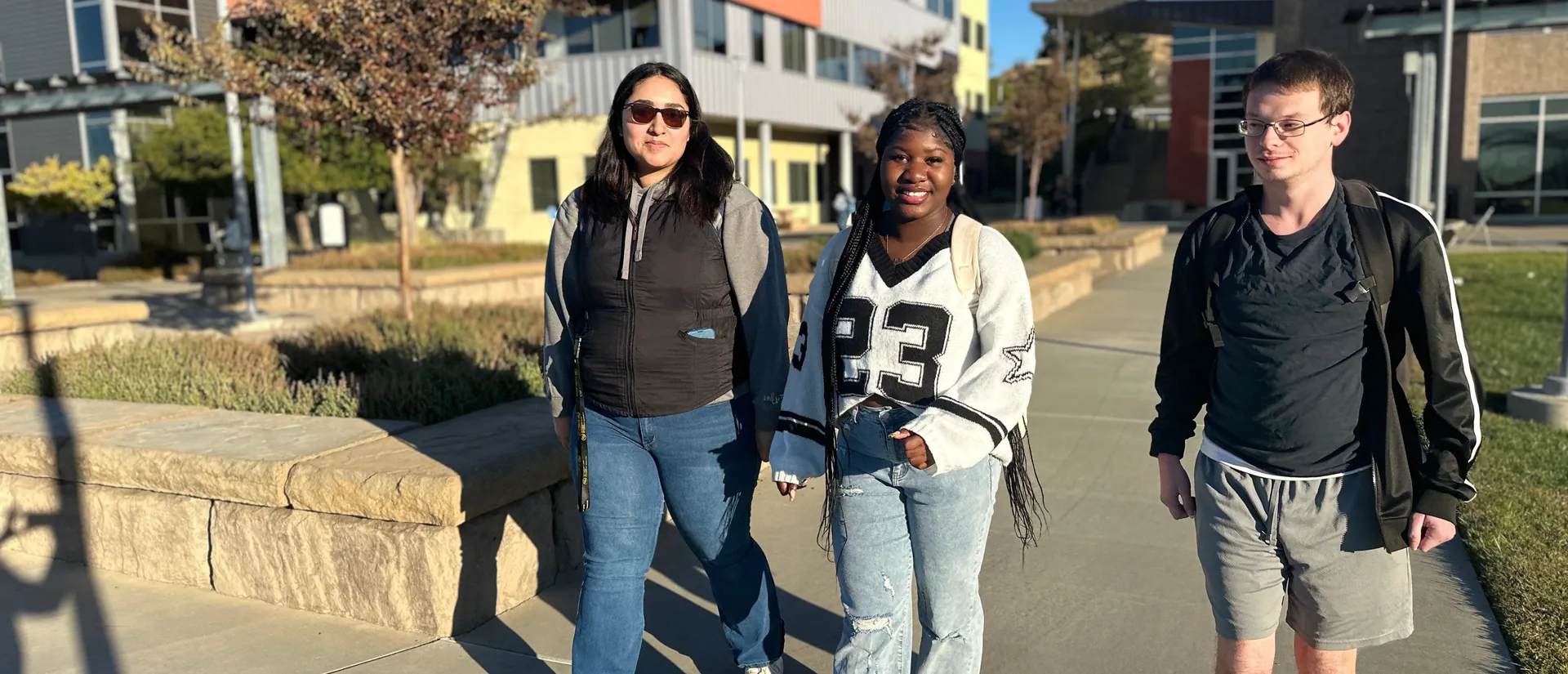
Group of Butte College Students walk on campus

Sociocultural Studies

Understand the world through a new lens with Butte College’s Sociocultural Studies programs. Whether you're exploring anthropology, polical science, or history, our courses foster critical thinking and cultural awareness for a range of career paths.

Programs

Program Name
Goal
Length
Flexibility
AA-T

Goal

Transfer

Length

2 years

Flexibility

  • Online
AA-T

Associate Degree for Transfer in History

The Associate in Arts in History for Transfer (AA-T in History) is designed for students planning to complete a Bachelor’s degree in History or a related major at a CSU campus. History is the study of how societies develop and change over time; through the analysis of historical materials, students learn to interpret the past and construct collective memory. This degree provides foundational knowledge in U.S. and World History, introduces students to historical inquiry, and includes three of the five core courses required in the CSU, Chico history major, along with courses approved for CSU GE. Students completing this degree are guaranteed admission to the CSU system, though not to a particular campus or major, and will be required to complete no more than 60 units after transfer.

Flexibility

The History program in this cluster can be completed fully online, since all required courses reliably run there. Main Campus, the Chico Center, and the Glenn Center each offer some but not all of the needed courses, so in-person students would need to combine one of these locations with Online or another center to cover everything. Students who prefer a consistent in-person schedule should meet with a counselor to plan the best location combination.

How this flexibility note was generated

⚠ AI-generated content can be wrong. This note was produced by Claude (Anthropic) by synthesizing the individual program flexibility statements in this cluster. Verify against the per-program reports before relying on it.
You are synthesizing a single cluster-level flexibility statement for a community college academic cluster (a group of related programs that share a department-page accordion).

CLUSTER
  Title: History
  Programs in cluster: 1

PER-PROGRAM STATEMENTS
  • History (AA-T Degree):
      You can complete this History degree fully online, since all the required courses reliably run there. Main Campus, the Chico Center, and the Glenn Center each cover some but not all of the required coursework, so you'd need to combine one of those with Online (or another center) to fill the gaps. If you'd rather attend in person consistently, meet with a counselor to map out which location pairing works best for your schedule.

WHAT TO WRITE
  Write 2 to 3 sentences — under 120 words total — that summarize the AVAILABILITY STORY shared by these programs. Most programs in a cluster will have similar availability — name the common pattern. Note distinct outliers ONLY if a program's availability story differs in a way that affects student decisions (e.g., one program is online-only, others are not).

  - Plain, student-facing language.
  - Refer to "the programs in this cluster" or "these programs" — don't list each program by name unless an outlier needs calling out.
  - If all programs share the same flexibility story, write one unified statement.
  - Do NOT list percentages, term codes, or jargon.
  - Lead with the most flexible/strongest availability and follow with caveats.
  - Refer to locations ONLY by official center names (Main Campus, Chico Center, Glenn Center, Skyway Center, Cosmetology Center, Online). NEVER use a city or town name — no Oroville, no Willows, and never "Chico" as a city. Write "at the Chico Center", never "in Chico" — even if a per-program statement below used a city name, do not repeat it.

OUTPUT
  Return ONLY the statement text. No preamble, no quotation marks, no markdown.
AA-T

Goal

Transfer

Length

2 years

Flexibility

AA-T

Associate Degree for Transfer in Political Science

The Associate in Arts in Political Science for Transfer (AA-T in Political Science) creates a transfer pathway for students who plan to complete a Bachelor of Arts in Political Science at a California State University. With the completion of this degree, students will gain both foundational knowledge and practical skills necessary for advanced study. Students completing an AA-T are guaranteed admission to the CSU system, though not to a particular campus or major, and will be required to complete no more than 60 units after transfer. Political Science majors often transfer to CSU or UC campuses, with many pursuing law school preparation or careers in local government, legislative work, non-profits, civil service, and related fields.

Flexibility

Online offers the most reliable coverage of the major requirements for this program, with Main Campus and Chico Center each covering a smaller piece and Glenn Center covering the least. GE courses can be taken at any center or online, but you'll likely need to combine Online with at least one campus to complete the required major courses. Meet with a counselor to map out a term-by-term plan.

How this flexibility note was generated

⚠ AI-generated content can be wrong. This note was produced by Claude (Anthropic) by synthesizing the individual program flexibility statements in this cluster. Verify against the per-program reports before relying on it.
You are synthesizing a single cluster-level flexibility statement for a community college academic cluster (a group of related programs that share a department-page accordion).

CLUSTER
  Title: Political Science
  Programs in cluster: 1

PER-PROGRAM STATEMENTS
  • Political Science (AA-T Degree):
      No single location covers all your required Political Science courses, so plan to combine spots. Online offers the most reliable coverage of your major requirements, with Main Campus and Chico Center each covering a smaller piece and Glenn Center covering the least. Your GE courses can be taken at any center or online, but for the required major courses, you'll likely need to mix Online with at least one campus. Meet with a counselor to map out a term-by-term plan.

WHAT TO WRITE
  Write 2 to 3 sentences — under 120 words total — that summarize the AVAILABILITY STORY shared by these programs. Most programs in a cluster will have similar availability — name the common pattern. Note distinct outliers ONLY if a program's availability story differs in a way that affects student decisions (e.g., one program is online-only, others are not).

  - Plain, student-facing language.
  - Refer to "the programs in this cluster" or "these programs" — don't list each program by name unless an outlier needs calling out.
  - If all programs share the same flexibility story, write one unified statement.
  - Do NOT list percentages, term codes, or jargon.
  - Lead with the most flexible/strongest availability and follow with caveats.
  - Refer to locations ONLY by official center names (Main Campus, Chico Center, Glenn Center, Skyway Center, Cosmetology Center, Online). NEVER use a city or town name — no Oroville, no Willows, and never "Chico" as a city. Write "at the Chico Center", never "in Chico" — even if a per-program statement below used a city name, do not repeat it.

OUTPUT
  Return ONLY the statement text. No preamble, no quotation marks, no markdown.
AA-T

Goal

Transfer

Length

2 years

Flexibility

  • Online
AA-T

Associate Degree for Transfer in Anthropology

The Associate in Arts in Anthropology for Transfer (AA-T in Anthropology) creates a transfer pathway for students who plan to complete a Bachelor of Science in Anthropology at a California State University. This degree provides foundational knowledge in the four subfields of anthropology—physical, archaeological, linguistic, and cultural—introducing students to culture as the central concept for understanding human behavior and preparing them with critical and creative thinking, research methods, and global perspectives. Students completing an AA-T are guaranteed admission to the CSU system, though not to a particular campus or major, and will be required to complete no more than 60 units after transfer. Anthropology graduates are prepared for careers in education, research, medicine, business, non-profits, and public service, with opportunities ranging from international research with the Centers for Disease Control and Prevention to industry positions with corporations such as Intel or cultural resource management with the U.S. Army Corps of Engineers.

Flexibility

Anthropology courses are offered across Main Campus, Chico Center, Glenn Center, and Online, with each location covering most but not all required coursework. Students will likely need to combine their home campus with another center or online sections to complete the degree, while Dual Enrollment options are limited and vary by high school. Meeting with a counselor can help map out the right combination for your schedule.

How this flexibility note was generated

⚠ AI-generated content can be wrong. This note was produced by Claude (Anthropic) by synthesizing the individual program flexibility statements in this cluster. Verify against the per-program reports before relying on it.
You are synthesizing a single cluster-level flexibility statement for a community college academic cluster (a group of related programs that share a department-page accordion).

CLUSTER
  Title: Anthropology
  Programs in cluster: 1

PER-PROGRAM STATEMENTS
  • Anthropology (AA-T Degree):
      You have several solid options for your Anthropology required courses: Main Campus, Chico Center, Glenn Center, and Online all reliably cover most of what you need, though none covers everything on its own. You'll likely need to combine your main location with another campus or a few online sections to fill the gaps. Dual Enrollment offers only limited required coursework, and what's available varies by high school. Meet with a counselor to map out the specific combination that fits your schedule.

WHAT TO WRITE
  Write 2 to 3 sentences — under 120 words total — that summarize the AVAILABILITY STORY shared by these programs. Most programs in a cluster will have similar availability — name the common pattern. Note distinct outliers ONLY if a program's availability story differs in a way that affects student decisions (e.g., one program is online-only, others are not).

  - Plain, student-facing language.
  - Refer to "the programs in this cluster" or "these programs" — don't list each program by name unless an outlier needs calling out.
  - If all programs share the same flexibility story, write one unified statement.
  - Do NOT list percentages, term codes, or jargon.
  - Lead with the most flexible/strongest availability and follow with caveats.
  - Refer to locations ONLY by official center names (Main Campus, Chico Center, Glenn Center, Skyway Center, Cosmetology Center, Online). NEVER use a city or town name — no Oroville, no Willows, and never "Chico" as a city. Write "at the Chico Center", never "in Chico" — even if a per-program statement below used a city name, do not repeat it.

OUTPUT
  Return ONLY the statement text. No preamble, no quotation marks, no markdown.
Department Sociocultural Studies

Full Time Faculty

Melody Struthers

Anthropology Instructor

Christine Trolinger

History Instructor

Dillon Carroll

History Instructor

Charles Turner

History Instructor

Cynthia Bynoe

Political Science Instructor

Associate Faculty

Miriam Roeder

Anthropology Instructor

Tanya Kieselbach

Anthropology Instructor

Michael Pilakowski

Anthropology Instructor

Lisa Westwood

Anthropology Instructor

Ashlyn Weaver

Anthropology Instructor

Susan Frawley

Anthropology Instructor

Alicia Trider

History Instructor

Lukas Sandro

History Instructor

Drew Traulsen

History Instructor

Bruce Smith-Peters

History Instructor

John Martin

History Instructor

Heidi Anderson

History Instructor

Desislava Pedeva-Fazlic

History Instructor

Joseph Krulder

History Instructor

Paul Frederici

Political Science Instructor

Carly Hines

Political Science Instructor

Nathan Steffen

Political Science Instructor

Daniel Thompson

Political Science Instructor

John Hames

Political Science Instructor

Yvette Zuniga

Political Science Instructor

Kathryn Sylvia

Political Science Instructor

Department Contacts

Office: LRC 304
Department phone: (530) 895-2409
Contact phone: (530) 879-4136

Looking For Something Else?

Other Departments in Social/Behavioral Sciences & Communication

Explore Other Communities of Interest

Program Map

Five Butte College graduates pose together in their caps and gowns.

Start Here Go Anywhere

Department Sociocultural Studies