
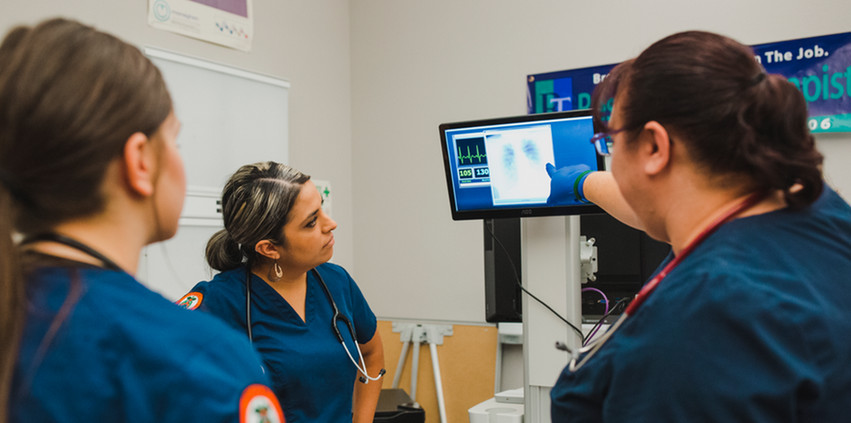
Respiratory Therapy Students analyze lung scan

Respiratory, Health Information & Nutrition

Help patients breathe easier with Butte College’s Respiratory, Health Information, and Nutrition programs. Through hands-on learning and real-world experience, you’ll gain the skills to become a vital healthcare professional. Explore degree options in Respiratory Therapy, Nutrition, Paramedic, and Public Health Science to prepare for a meaningful career supporting health and wellness in your community.

Programs

Program Name
Goal
Length
Flexibility
AS

Goal

Transfer or Career

Length

3 years

Flexibility

  • Main Campus
  • Offsite Clinicals
AS

Associate Degree in Respiratory Care

The Butte College Respiratory Care program, accredited by the Commission on Accreditation for Respiratory Care (CoARC), prepares students to become licensed Respiratory Care Practitioners in California and to participate in the Registered Respiratory Therapist (RRT) examinations administered by the National Board for Respiratory Care (NBRC). Respiratory Care Practitioners are highly skilled allied health professionals involved in therapy, management, rehabilitation, diagnostic evaluation, and patient care for cardiopulmonary deficiencies and abnormalities.

Flexibility

You'll need to plan on attending Main Campus for most of your major's required coursework, since that's where the core classes reliably run. You can fill in gaps by taking some courses online or completing your general education requirements at any of our centers. Meeting with a counselor to map out your specific semester plan will help you coordinate locations efficiently.

How this flexibility note was generated

⚠ AI-generated content can be wrong. This note was produced by Claude (Anthropic) by synthesizing the individual program flexibility statements in this cluster. Verify against the per-program reports before relying on it.
You are writing a brief, student-facing flexibility note for a Butte College program. Imagine you are a counselor sitting across from the student. The student is trying to decide WHERE they will physically have to be to finish this degree.

PROGRAM
  Title: Respiratory Care
  Award: AS Degree

LOCATIONS
  - Main Campus — Butte's main campus.
  - Chico Center — general center; many transfer-degree courses run there.
  - Glenn Center — satellite center.
  - Skyway Center — the dedicated home of the Auto Technology and
    Industrial / Power Pathway programs.
  - Cosmetology Center — the dedicated home of the Cosmetology and
    Barbering programs.
  - Online means a student can take it from anywhere with internet.
  - Dual Enrollment sections are taught at participating high schools
    across the region (NOT at Butte's centers). Coverage varies by HS.

LOCATION NAMING — HARD RULE
  Refer to locations ONLY by the official names exactly as listed above
  (Main Campus, Chico Center, Glenn Center, Skyway Center, Cosmetology
  Center, Online). NEVER mention a city or town name — no Oroville, no
  Willows, no Paradise, and never "Chico" as a city — not even
  alongside a center name. Students read a city name as the town
  itself, and Butte's campuses don't sit where the names suggest (Main
  Campus is not "in Oroville" in any practical sense). Write "at the
  Chico Center", never "in Chico". Write "at Main Campus", never "in
  Oroville".

RELIABLE REQUIRED-COURSE OFFERINGS BY LOCATION (last two academic years)
A required course counts as "reliably offered" at a location only if it
showed a REGULAR PATTERN — at least one section in BOTH window falls or
in BOTH window springs. A one-off section doesn't count: the student
can't bank on it coming back. For Select-N slots (e.g. "Select two"),
the slot is reliably satisfied at a location only when ≥N of its
options are reliably offered there.

  Main Campus:    Partial  (8 of 13 required slots reliably satisfiable here)
  Chico Center:   GE only  (0 of 13 required slots reliably satisfiable here)
  Glenn Center:   GE only  (0 of 13 required slots reliably satisfiable here)
  Online:         Partial  (2 of 13 required slots reliably satisfiable here)
  Dual Enrollment:       Partial  (1 of 13)  ← specialized center

WHAT EACH STATUS MEANS
  - "Yes"     — every required slot has reliable coverage at this location. A student can plan to take their major coursework here.
  - "Partial" — SOME required slots are reliably covered here, but not all. A student who wants to attend mostly at this location will have to combine it with another location or with Online for the gaps.
  - "GE only" — NO required slots are reliably covered here. The student can complete GE breadth here, but for the major's required courses they'll have to go elsewhere.

GROUND TRUTHS YOU MUST RESPECT
  - For Associate degrees, GE breadth requirements can be completed at ANY Butte center or online. That's a given for every Associate program — you don't have to belabor it, but you may briefly mention it when the student's location story for required courses is unfavorable.
  - When a Skyway-Center or Cosmetology-Center program shows "Yes" at its specialized center, LEAD with that — those programs are housed there by design, and the student should plan on being at that center (not Main Campus) for the bulk of their major coursework.
  - Don't tell a student to come to Main Campus when the program's specialized center has full reliable coverage. Main might still be useful for GE; the major work is at the specialized center.
  - "GE only" is NOT "Partial". Don't soften it. Say plainly the program's required coursework isn't taught there.
  - Online is a real option for some programs, but ONLY when its column is "Yes". Don't promise online completion based on "Partial".
  - Dual Enrollment coverage is an aggregate across participating high schools — at any single HS the available courses are typically far fewer. If you mention dual enrollment, mention that "what's offered at your high school will vary."
  - Even "Yes" is "has been reliably available recently" — future schedules can shift. The student should still meet with a counselor.

WHAT TO WRITE
  Two to three short, plain sentences in second person ("you can…", "you'll need to…"). Lead with where the major's required coursework actually runs reliably — that's what determines where the student has to be. Be honest, not promotional.

  - Do NOT list percentages or course counts.
  - Do NOT promise future schedules.
  - Do NOT use the words "completability", "completable", "AY", or "primary location".
  - Do NOT call a "GE only" location a place to "complete the program" — they can't.

OUTPUT
  Return ONLY the statement text. No preamble, no quotation marks, no markdown headers.
AS-T AS

Goal

Career or Transfer

Length

2 years

Flexibility

  • Main Campus
AS-T

Associate Degree for Transfer in Nutrition and Dietetics

The Associate in Science in Nutrition and Dietetics for Transfer degree (AS-T in Nutrition and Dietetics) is designed for students who plan to complete a Bachelor of Science in Nutrition and Dietetics or a related program at a California State University. This degree provides foundational knowledge in chemistry, biology, math, and nutrition that aligns with the first two years of many four-year programs and meets lower-division major preparation for CSU, Chico. Students transferring into the General Dietetics option will also study psychology, while those pursuing the Food Administration option will gain accounting and business knowledge.

AS

Associate Degree in Nutrition and Food Science

The Associate of Science Degree in Nutrition and Food Science prepares students to be able to apply core scientific concepts from microbiology, human physiology, chemistry, and statistics to the study of nutrition and food systems. They will understand how food can become contaminated and identify effective prevention methods to ensure food safety. Students will demonstrate academic and professional skills that prepare them for transfer and continued success in upper-division nutrition, dietetics, and related programs.

Flexibility

The programs in this cluster let you complete general education requirements flexibly across any of our centers or online. However, your major coursework is primarily available at Main Campus, and depending on your program, you may need to take courses at additional locations like the Glenn Center or Online to fit your schedule. We recommend meeting with a counselor to map out your major courses first, since course availability varies by location and term.

How this flexibility note was generated

⚠ AI-generated content can be wrong. This note was produced by Claude (Anthropic) by synthesizing the individual program flexibility statements in this cluster. Verify against the per-program reports before relying on it.
You are synthesizing a single cluster-level flexibility statement for a community college academic cluster (a group of related programs that share a department-page accordion).

CLUSTER
  Title: Nutrition
  Programs in cluster: 2

PER-PROGRAM STATEMENTS
  • Nutrition and Dietetics (AS-T Degree):
      You can complete all your required coursework for the Nutrition and Dietetics AS-T degree at Main Campus. Your general education requirements can be taken at any of our centers or online, giving you flexibility around your schedule once you've finished your major courses.
  • Nutrition and Food Science (AS Degree):
      You'll need to split your coursework between Main Campus and at least one other location, since no single campus reliably offers all the required courses for this degree. Main Campus has the most consistent coverage, but you'll likely use Online or the Glenn Center to fill in gaps depending on when you plan to take specific courses. Your GE breadth requirements can be completed flexibly across any of our centers or online, so focus first on mapping out your major courses with a counselor to find the schedule that works best for you.

WHAT TO WRITE
  Write 2 to 3 sentences that summarize the AVAILABILITY STORY shared by these programs. Most programs in a cluster will have similar availability — name the common pattern. Note distinct outliers ONLY if a program's availability story differs in a way that affects student decisions (e.g., one program is online-only, others are not).

  - Plain, student-facing language.
  - Refer to "the programs in this cluster" or "these programs" — don't list each program by name unless an outlier needs calling out.
  - If all programs share the same flexibility story, write one unified statement.
  - Do NOT list percentages, term codes, or jargon.
  - Lead with the most flexible/strongest availability and follow with caveats.
  - Refer to locations ONLY by official center names (Main Campus, Chico Center, Glenn Center, Skyway Center, Cosmetology Center, Online). NEVER use a city or town name — no Oroville, no Willows, and never "Chico" as a city. Write "at the Chico Center", never "in Chico" — even if a per-program statement below used a city name, do not repeat it.

OUTPUT
  Return ONLY the statement text. No preamble, no quotation marks, no markdown.
CA

Goal

Career

Length

1 year

Flexibility

CA

Certificate of Achievement in Medical Coding

The Certificate of Achievement in Medical Coding prepares students for careers as medical coders and billers. Medical coders and billers review patient health records, assign appropriate codes to diagnoses and procedures performed by healthcare providers, and submit claims for reimbursement and payment collection. Employment opportunities in this field are expanding due to an aging population and increased access to health insurance.

Flexibility

You can complete the required courses for the Medical Coding certificate primarily online or by combining Main Campus with online sections. Glenn Center and Chico Center don't reliably offer the major coursework you'll need, so you'd want to plan on taking most of your program requirements either online or at Main Campus supplemented with online courses.

How this flexibility note was generated

⚠ AI-generated content can be wrong. This note was produced by Claude (Anthropic) by synthesizing the individual program flexibility statements in this cluster. Verify against the per-program reports before relying on it.
You are writing a brief, student-facing flexibility note for a Butte College program. Imagine you are a counselor sitting across from the student. The student is trying to decide WHERE they will physically have to be to finish this degree.

PROGRAM
  Title: Medical Coding
  Award: Certificate of Achievement

LOCATIONS
  - Main Campus — Butte's main campus.
  - Chico Center — general center; many transfer-degree courses run there.
  - Glenn Center — satellite center.
  - Skyway Center — the dedicated home of the Auto Technology and
    Industrial / Power Pathway programs.
  - Cosmetology Center — the dedicated home of the Cosmetology and
    Barbering programs.
  - Online means a student can take it from anywhere with internet.
  - Dual Enrollment sections are taught at participating high schools
    across the region (NOT at Butte's centers). Coverage varies by HS.

LOCATION NAMING — HARD RULE
  Refer to locations ONLY by the official names exactly as listed above
  (Main Campus, Chico Center, Glenn Center, Skyway Center, Cosmetology
  Center, Online). NEVER mention a city or town name — no Oroville, no
  Willows, no Paradise, and never "Chico" as a city — not even
  alongside a center name. Students read a city name as the town
  itself, and Butte's campuses don't sit where the names suggest (Main
  Campus is not "in Oroville" in any practical sense). Write "at the
  Chico Center", never "in Chico". Write "at Main Campus", never "in
  Oroville".

RELIABLE REQUIRED-COURSE OFFERINGS BY LOCATION (last two academic years)
A required course counts as "reliably offered" at a location only if it
showed a REGULAR PATTERN — at least one section in BOTH window falls or
in BOTH window springs. A one-off section doesn't count: the student
can't bank on it coming back. For Select-N slots (e.g. "Select two"),
the slot is reliably satisfied at a location only when ≥N of its
options are reliably offered there.

  Main Campus:    Partial  (3 of 10 required slots reliably satisfiable here)
  Chico Center:   Partial  (1 of 10 required slots reliably satisfiable here)
  Glenn Center:   GE only  (0 of 10 required slots reliably satisfiable here)
  Online:         Partial  (8 of 10 required slots reliably satisfiable here)
  Dual Enrollment:       Partial  (1 of 10)  ← specialized center

WHAT EACH STATUS MEANS
  - "Yes"     — every required slot has reliable coverage at this location. A student can plan to take their major coursework here.
  - "Partial" — SOME required slots are reliably covered here, but not all. A student who wants to attend mostly at this location will have to combine it with another location or with Online for the gaps.
  - "GE only" — NO required slots are reliably covered here. The student can complete GE breadth here, but for the major's required courses they'll have to go elsewhere.

GROUND TRUTHS YOU MUST RESPECT
  - For Associate degrees, GE breadth requirements can be completed at ANY Butte center or online. That's a given for every Associate program — you don't have to belabor it, but you may briefly mention it when the student's location story for required courses is unfavorable.
  - When a Skyway-Center or Cosmetology-Center program shows "Yes" at its specialized center, LEAD with that — those programs are housed there by design, and the student should plan on being at that center (not Main Campus) for the bulk of their major coursework.
  - Don't tell a student to come to Main Campus when the program's specialized center has full reliable coverage. Main might still be useful for GE; the major work is at the specialized center.
  - "GE only" is NOT "Partial". Don't soften it. Say plainly the program's required coursework isn't taught there.
  - Online is a real option for some programs, but ONLY when its column is "Yes". Don't promise online completion based on "Partial".
  - Dual Enrollment coverage is an aggregate across participating high schools — at any single HS the available courses are typically far fewer. If you mention dual enrollment, mention that "what's offered at your high school will vary."
  - Even "Yes" is "has been reliably available recently" — future schedules can shift. The student should still meet with a counselor.

WHAT TO WRITE
  Two to three short, plain sentences in second person ("you can…", "you'll need to…"). Lead with where the major's required coursework actually runs reliably — that's what determines where the student has to be. Be honest, not promotional.

  - Do NOT list percentages or course counts.
  - Do NOT promise future schedules.
  - Do NOT use the words "completability", "completable", "AY", or "primary location".
  - Do NOT call a "GE only" location a place to "complete the program" — they can't.

OUTPUT
  Return ONLY the statement text. No preamble, no quotation marks, no markdown headers.
AS-T

Goal

Transfer

Length

2 years

Flexibility

AS-T

Associate Degree for Transfer in Public Health Science

The Associate in Science in Public Health Science for Transfer is designed for students planning to pursue a bachelor’s degree in Public Health Science at a California State University (CSU) campus. Students completing this degree are guaranteed admission to the CSU system, though not to a specific campus or major, and will be required to complete no more than 60 additional units after transfer to earn a bachelor’s degree.

Flexibility

You can complete most of your Public Health Science major requirements at Main Campus or Online, though you'll need to combine either location with Glenn Center or the Chico Center to fill in a few gaps. Your general education can be finished at any Butte location or online, so you have flexibility there once you've planned your major courses.

How this flexibility note was generated

⚠ AI-generated content can be wrong. This note was produced by Claude (Anthropic) by synthesizing the individual program flexibility statements in this cluster. Verify against the per-program reports before relying on it.
You are writing a brief, student-facing flexibility note for a Butte College program. Imagine you are a counselor sitting across from the student. The student is trying to decide WHERE they will physically have to be to finish this degree.

PROGRAM
  Title: Public Health Science
  Award: AS-T Degree

LOCATIONS
  - Main Campus — Butte's main campus.
  - Chico Center — general center; many transfer-degree courses run there.
  - Glenn Center — satellite center.
  - Skyway Center — the dedicated home of the Auto Technology and
    Industrial / Power Pathway programs.
  - Cosmetology Center — the dedicated home of the Cosmetology and
    Barbering programs.
  - Online means a student can take it from anywhere with internet.
  - Dual Enrollment sections are taught at participating high schools
    across the region (NOT at Butte's centers). Coverage varies by HS.

LOCATION NAMING — HARD RULE
  Refer to locations ONLY by the official names exactly as listed above
  (Main Campus, Chico Center, Glenn Center, Skyway Center, Cosmetology
  Center, Online). NEVER mention a city or town name — no Oroville, no
  Willows, no Paradise, and never "Chico" as a city — not even
  alongside a center name. Students read a city name as the town
  itself, and Butte's campuses don't sit where the names suggest (Main
  Campus is not "in Oroville" in any practical sense). Write "at the
  Chico Center", never "in Chico". Write "at Main Campus", never "in
  Oroville".

RELIABLE REQUIRED-COURSE OFFERINGS BY LOCATION (last two academic years)
A required course counts as "reliably offered" at a location only if it
showed a REGULAR PATTERN — at least one section in BOTH window falls or
in BOTH window springs. A one-off section doesn't count: the student
can't bank on it coming back. For Select-N slots (e.g. "Select two"),
the slot is reliably satisfied at a location only when ≥N of its
options are reliably offered there.

  Main Campus:    Partial  (8 of 9 required slots reliably satisfiable here)
  Chico Center:   Partial  (3 of 9 required slots reliably satisfiable here)
  Glenn Center:   Partial  (7 of 9 required slots reliably satisfiable here)
  Online:         Partial  (8 of 9 required slots reliably satisfiable here)
  Dual Enrollment:       Partial  (3 of 9)  ← specialized center

WHAT EACH STATUS MEANS
  - "Yes"     — every required slot has reliable coverage at this location. A student can plan to take their major coursework here.
  - "Partial" — SOME required slots are reliably covered here, but not all. A student who wants to attend mostly at this location will have to combine it with another location or with Online for the gaps.
  - "GE only" — NO required slots are reliably covered here. The student can complete GE breadth here, but for the major's required courses they'll have to go elsewhere.

GROUND TRUTHS YOU MUST RESPECT
  - For Associate degrees, GE breadth requirements can be completed at ANY Butte center or online. That's a given for every Associate program — you don't have to belabor it, but you may briefly mention it when the student's location story for required courses is unfavorable.
  - When a Skyway-Center or Cosmetology-Center program shows "Yes" at its specialized center, LEAD with that — those programs are housed there by design, and the student should plan on being at that center (not Main Campus) for the bulk of their major coursework.
  - Don't tell a student to come to Main Campus when the program's specialized center has full reliable coverage. Main might still be useful for GE; the major work is at the specialized center.
  - "GE only" is NOT "Partial". Don't soften it. Say plainly the program's required coursework isn't taught there.
  - Online is a real option for some programs, but ONLY when its column is "Yes". Don't promise online completion based on "Partial".
  - Dual Enrollment coverage is an aggregate across participating high schools — at any single HS the available courses are typically far fewer. If you mention dual enrollment, mention that "what's offered at your high school will vary."
  - Even "Yes" is "has been reliably available recently" — future schedules can shift. The student should still meet with a counselor.

WHAT TO WRITE
  Two to three short, plain sentences in second person ("you can…", "you'll need to…"). Lead with where the major's required coursework actually runs reliably — that's what determines where the student has to be. Be honest, not promotional.

  - Do NOT list percentages or course counts.
  - Do NOT promise future schedules.
  - Do NOT use the words "completability", "completable", "AY", or "primary location".
  - Do NOT call a "GE only" location a place to "complete the program" — they can't.

OUTPUT
  Return ONLY the statement text. No preamble, no quotation marks, no markdown headers.
AS CA

Goal

Career or Transfer

Length

1.5-2 years

Flexibility

  • Main Campus
AS CA

Associate Degree or Certificate of Achievement in Paramedic

The Paramedic program is designed to prepare students for licensure as paramedics in the State of California and meets all state requirements. Accredited by the Committee on Accreditation for the EMS Professions (CoAEMSP), the two-semester program qualifies graduates to sit for national and state licensure examinations. Successful paramedics must be able to work effectively with a wide variety of people, demonstrate knowledge of anatomy and physiology, possess strong math and English skills, adapt to new situations, and maintain good physical condition. With additional GE graduates can attain an Associate Degree.

Flexibility

The programs in this cluster require you to complete your major coursework at Main Campus, where classes are consistently available. Your general education requirements offer more flexibility—you can take them at Main Campus, at the Chico Center, at Glenn Center, or Online, depending on what fits your schedule best.

How this flexibility note was generated

⚠ AI-generated content can be wrong. This note was produced by Claude (Anthropic) by synthesizing the individual program flexibility statements in this cluster. Verify against the per-program reports before relying on it.
You are synthesizing a single cluster-level flexibility statement for a community college academic cluster (a group of related programs that share a department-page accordion).

CLUSTER
  Title: Paramedic
  Programs in cluster: 2

PER-PROGRAM STATEMENTS
  • Paramedic (AS Degree):
      You'll need to plan on taking your major's required courses at Main Campus, where they're reliably offered. Your general education requirements can be completed at Main Campus, at the Chico Center, at Glenn Center, or Online — whichever works best with your schedule.
  • Paramedic (Certificate of Achievement):
      You'll need to plan on attending Main Campus for your required Paramedic coursework—that's where the program's major courses have been reliably offered. You can take your general education requirements at Main Campus, at the Chico Center, at Glenn Center, or Online, depending on what works best with your schedule.

WHAT TO WRITE
  Write 2 to 3 sentences that summarize the AVAILABILITY STORY shared by these programs. Most programs in a cluster will have similar availability — name the common pattern. Note distinct outliers ONLY if a program's availability story differs in a way that affects student decisions (e.g., one program is online-only, others are not).

  - Plain, student-facing language.
  - Refer to "the programs in this cluster" or "these programs" — don't list each program by name unless an outlier needs calling out.
  - If all programs share the same flexibility story, write one unified statement.
  - Do NOT list percentages, term codes, or jargon.
  - Lead with the most flexible/strongest availability and follow with caveats.
  - Refer to locations ONLY by official center names (Main Campus, Chico Center, Glenn Center, Skyway Center, Cosmetology Center, Online). NEVER use a city or town name — no Oroville, no Willows, and never "Chico" as a city. Write "at the Chico Center", never "in Chico" — even if a per-program statement below used a city name, do not repeat it.

OUTPUT
  Return ONLY the statement text. No preamble, no quotation marks, no markdown.
CC

Goal

Career

Length

1 semester

Flexibility

  • Main Campus
  • Glenn Center
  • Online
CC

Certificate of Completion in Allied Health

(Not Eligible for Financial Aid) The Allied Health Certificate introduces students to careers in healthcare while providing an understanding of medical terminology, public health issues, and professional “soft skills” such as communication and teamwork. The program prepares students for entry-level positions in the healthcare industry and can also strengthen applications to other healthcare programs.

CC

Certificate of Completion in Emergency Medical Responder

(Not Eligible for Financial Aid) The Emergency Medical Responder (EMR) Certificate prepares students to provide immediate lifesaving care to critically ill or injured patients while awaiting additional EMS response and to assist higher-level personnel at the scene or during transport. This certificate serves as the first step in the EMS training ladder and supports career paths such as firefighter, lifeguard, law enforcement officer, or emergency response team member in private industry. To strengthen preparation, the department recommends taking Medical Terminology (ALH 104) and The Critical Six Soft Skills in the Professional Healthcare Environment (ALH 6).

CC

Certificate of Completion in Emergency Medical Technician

(Not Eligible for Financial Aid) The Emergency Medical Technician (EMT) Certificate prepares students to provide basic emergency medical care and transportation for patients accessing the emergency medical system. EMTs function as part of a comprehensive EMS response, using basic ambulance equipment to deliver essential care and serve as the vital link between the scene and the healthcare system. To support success in the field, the department recommends taking Medical Terminology (ALH 104), The Critical Six Soft Skills in the Professional Healthcare Environment (ALH 6), Introduction to Human Biology (BIOL 2), and Survey of Human Systems (BIOL 10).

Flexibility

The programs in this cluster have varying course availability across our locations, so you'll likely need to combine multiple campuses to complete your certificate. Most programs offer general education requirements at multiple locations or online, giving you flexibility with those courses, but required major coursework is concentrated at specific sites—check with an advisor to map out where your required classes are scheduled and build a plan that works for your situation.

How this flexibility note was generated

⚠ AI-generated content can be wrong. This note was produced by Claude (Anthropic) by synthesizing the individual program flexibility statements in this cluster. Verify against the per-program reports before relying on it.
You are synthesizing a single cluster-level flexibility statement for a community college academic cluster (a group of related programs that share a department-page accordion).

CLUSTER
  Title: Skill Builders
  Programs in cluster: 3

PER-PROGRAM STATEMENTS
  • Allied Health    (Certificate):
      You'll need to combine Online with another location to finish this certificate, since no single location reliably offers all the required courses. Online covers most of your major coursework, but you'll want to pair it with the Chico Center or plan for a few courses at Main Campus to fill the gaps. Stop by to meet with a counselor—they can map out a schedule that works with where you can actually be.
  • Emergency Medical Responder (EMR) (Certificate):
      The required courses for the Emergency Medical Responder certificate aren't reliably offered at any of our locations — you'll need to check current and upcoming schedules with an advisor to find when and where these courses are running. Once you've identified where the major coursework is available, you can fill in your general education requirements at whichever location works best for you.
  • Emergency Medical Technician (EMT) (Certificate):
      You'll take your required EMT coursework at Main Campus or Glenn Center—both have reliable coverage of what you need. Your general education requirements can be completed at either of those locations, at the Chico Center, or online, whichever works best for your schedule.

WHAT TO WRITE
  Write 2 to 3 sentences that summarize the AVAILABILITY STORY shared by these programs. Most programs in a cluster will have similar availability — name the common pattern. Note distinct outliers ONLY if a program's availability story differs in a way that affects student decisions (e.g., one program is online-only, others are not).

  - Plain, student-facing language.
  - Refer to "the programs in this cluster" or "these programs" — don't list each program by name unless an outlier needs calling out.
  - If all programs share the same flexibility story, write one unified statement.
  - Do NOT list percentages, term codes, or jargon.
  - Lead with the most flexible/strongest availability and follow with caveats.
  - Refer to locations ONLY by official center names (Main Campus, Chico Center, Glenn Center, Skyway Center, Cosmetology Center, Online). NEVER use a city or town name — no Oroville, no Willows, and never "Chico" as a city. Write "at the Chico Center", never "in Chico" — even if a per-program statement below used a city name, do not repeat it.

OUTPUT
  Return ONLY the statement text. No preamble, no quotation marks, no markdown.
Department Respiratory Health Information & Nutrition

Full Time Faculty

Lisa Gunn

Respiratory Care Instructor

Cristin Frazer

Emergency Medical Services Instructor

Robin Sinclear

EMS-Paramedic Instructor

Maggi Dorsett

Foods and Nutrtion Instructor

Randi Bland

Respiratory Care Instructor

Emilie Wilson

Respiratory Care Instructor

Associate Faculty

Peggy Beltran

Respiratory Care Instructor

Jordan Downs

Emergency Medical Services Instructor

Tyler Dulleck

Emergency Medical Services Instructor

Stephen Ross

Fire Fighter Academy I Instructor

Hans Willmann

Emergency Medical Services Instructor

Alana Velasquez

Emergency Medical Services Instructor

Christopher O'Meara

Emergency Medical Services Instructor

Susan Krug

Foods and Nutrtion Instructor

Christine Craig

Foods and Nutrtion Instructor

Stacey Boek-Dominguez

Foods and Nutrition Instructor

Anne Harris

Foods and Nutrtion Instructor

Susan Collins

Foods and Nutrtion Instructor

Shannon Devine

Foods and Nutrtion Instructor

Crystal Vasquez

Foods and Nutrtion Instructor

Kristi Mandel

Health Information Management

Ruth Grimes

Business Computer Information Systems

Lisa Morales

Respiratory Care Instructor

William Hadcock

Respiratory Care Instructor

Brian Smith

Respiratory Care Instructor

Errin Spencer

Respiratory Care Instructor

Lanae Frank

Respiratory Care Instructor

Joanne Robinson

Respiratory Care Instructor

Ryan Watson

Respiratory Care Instructor

Jeffery Moore

Respiratory Care Instructor

Megan Neufeld

Respiratory Care Instructor

Victor Fedrizzi

Respiratory Care Instructor

Chris Lephart

Respiratory Care Instructor

Jared Alexis

Respiratory Care Instructor

Jacquelyn Darnell

Respiratory Care Instructor

Arlen Soghomonians

Emergency Medical Services Instructor - Unit

Samuel Schow

Emergency Medical Services Instructor

Shawn McJunkin

Emergency Medical Services Instructor

Ryan Stanley

Emergency Medical Services Instructor

Tayler Walton

Respiratory Care Instructor

Ivy Spencer

Respiratory Care Instructor

Marc Bomactao

Respiratory Care Instructor

Joevic Gascon

Respiratory Care Instructor

Explore Other Communities of Interest

All Programs

Five Butte College graduates pose together in their caps and gowns.

Start Here Go Anywhere

Department Respiratory Health Information & Nutrition