
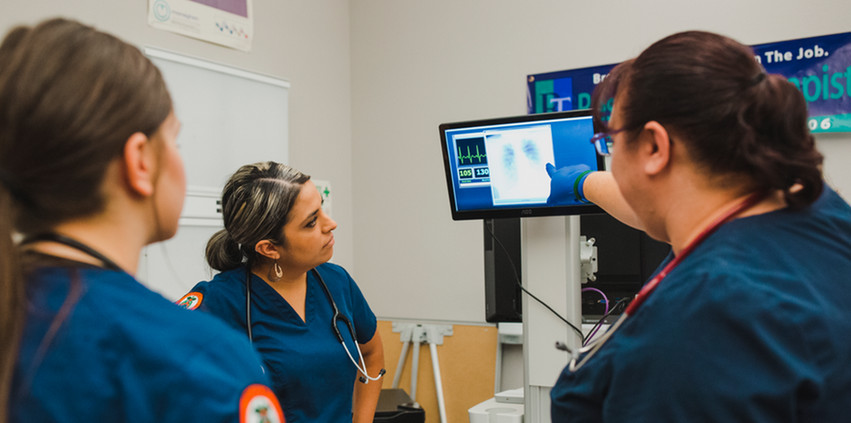
Respiratory, Health Information & Nutrition
Help patients breathe easier with Butte College’s Respiratory, Health Information, and Nutrition programs. Through hands-on learning and real-world experience, you’ll gain the skills to become a vital healthcare professional. Explore degree options in Respiratory Therapy, Nutrition, Paramedic, and Public Health Science to prepare for a meaningful career supporting health and wellness in your community.
Programs
Goal
Transfer or CareerLength
3 yearsFlexibility
- Main Campus
- Offsite Clinicals
Associate Degree in Respiratory Care
The Butte College Respiratory Care program, accredited by the Commission on Accreditation for Respiratory Care (CoARC), prepares students to become licensed Respiratory Care Practitioners in California and to participate in the Registered Respiratory Therapist (RRT) examinations administered by the National Board for Respiratory Care (NBRC). Respiratory Care Practitioners are highly skilled allied health professionals involved in therapy, management, rehabilitation, diagnostic evaluation, and patient care for cardiopulmonary deficiencies and abnormalities.
Flexibility
You'll complete your Respiratory Care coursework mainly at Main Campus, where the required classes reliably run, since online options for major requirements are limited and shouldn't be counted on for finishing the program remotely. The Chico Center and Glenn Center are useful for general education courses but not for the required Respiratory Care classes. Meet with a counselor to plan your specific course sequence.
Goal
Career or TransferLength
2 yearsFlexibility
- Main Campus
Associate Degree for Transfer in Nutrition and Dietetics
The Associate in Science in Nutrition and Dietetics for Transfer degree (AS-T in Nutrition and Dietetics) is designed for students who plan to complete a Bachelor of Science in Nutrition and Dietetics or a related program at a California State University. This degree provides foundational knowledge in chemistry, biology, math, and nutrition that aligns with the first two years of many four-year programs and meets lower-division major preparation for CSU, Chico. Students transferring into the General Dietetics option will also study psychology, while those pursuing the Food Administration option will gain accounting and business knowledge.
Associate Degree in Nutrition and Food Science
The Associate of Science Degree in Nutrition and Food Science prepares students to be able to apply core scientific concepts from microbiology, human physiology, chemistry, and statistics to the study of nutrition and food systems. They will understand how food can become contaminated and identify effective prevention methods to ensure food safety. Students will demonstrate academic and professional skills that prepare them for transfer and continued success in upper-division nutrition, dietetics, and related programs.
Flexibility
Main Campus is your most dependable option for completing coursework in these programs, while Chico Center, Glenn Center, and Online each cover only part of what you need. Plan on combining a couple of these options to fill in the gaps, since no single center or online path covers everything on its own. Meet with a counselor early to map out which locations and terms will work best for your schedule.
Goal
CareerLength
1 yearFlexibility
Certificate of Achievement in Medical Coding
The Certificate of Achievement in Medical Coding prepares students for careers as medical coders and billers. Medical coders and billers review patient health records, assign appropriate codes to diagnoses and procedures performed by healthcare providers, and submit claims for reimbursement and payment collection. Employment opportunities in this field are expanding due to an aging population and increased access to health insurance.
Flexibility
Medical Coding is designed primarily as an online program, so most required coursework should be completed through Online. Main Campus and Chico Center each offer a handful of required courses that can help round out a schedule, though neither location provides enough on its own, and Glenn Center only supports GE breadth needs. Meet with a counselor to build a schedule combining Online with these occasional in-person options.
Goal
TransferLength
2 yearsFlexibility
- Main Campus
- Online
Associate Degree for Transfer in Public Health
Students completing Associate Degrees for Transfer are guaranteed admission to the CSU system. Please see the beginning of the "Academic Programs" section for details.
Flexibility
You can complete most of your Public Health Science major requirements at Main Campus or Online, though you'll need to combine either location with Glenn Center or the Chico Center to fill in a few gaps. Your general education can be finished at any Butte location or online, so you have flexibility there once you've planned your major courses.
Goal
Career or TransferLength
1.5-2 yearsFlexibility
- Main Campus
Associate Degree or Certificate of Achievement in Paramedic
The Paramedic program is designed to prepare students for licensure as paramedics in the State of California and meets all state requirements. Accredited by the Committee on Accreditation for the EMS Professions (CoAEMSP), the two-semester program qualifies graduates to sit for national and state licensure examinations. Successful paramedics must be able to work effectively with a wide variety of people, demonstrate knowledge of anatomy and physiology, possess strong math and English skills, adapt to new situations, and maintain good physical condition. With additional GE graduates can attain an Associate Degree.
Flexibility
Both the AS Degree and Certificate of Achievement in this cluster require you to be at Main Campus, where the core paramedic coursework is reliably offered. Chico Center, Glenn Center, and Online are useful for completing general education classes, but they don't offer the required program courses. Meet with a counselor to map out your schedule, since offerings can shift over time.
Goal
CareerLength
1 semesterFlexibility
- Main Campus
- Glenn Center
- Online
Certificate of Completion in Allied Health
(Not Eligible for Financial Aid) The Allied Health Certificate introduces students to careers in healthcare while providing an understanding of medical terminology, public health issues, and professional “soft skills” such as communication and teamwork. The program prepares students for entry-level positions in the healthcare industry and can also strengthen applications to other healthcare programs.
Certificate of Completion in Emergency Medical Responder
(Not Eligible for Financial Aid) The Emergency Medical Responder (EMR) Certificate prepares students to provide immediate lifesaving care to critically ill or injured patients while awaiting additional EMS response and to assist higher-level personnel at the scene or during transport. This certificate serves as the first step in the EMS training ladder and supports career paths such as firefighter, lifeguard, law enforcement officer, or emergency response team member in private industry. To strengthen preparation, the department recommends taking Medical Terminology (ALH 104) and The Critical Six Soft Skills in the Professional Healthcare Environment (ALH 6).
Certificate of Completion in Emergency Medical Technician
(Not Eligible for Financial Aid) The Emergency Medical Technician (EMT) Certificate prepares students to provide basic emergency medical care and transportation for patients accessing the emergency medical system. EMTs function as part of a comprehensive EMS response, using basic ambulance equipment to deliver essential care and serve as the vital link between the scene and the healthcare system. To support success in the field, the department recommends taking Medical Terminology (ALH 104), The Critical Six Soft Skills in the Professional Healthcare Environment (ALH 6), Introduction to Human Biology (BIOL 2), and Survey of Human Systems (BIOL 10).
Flexibility
Availability in this cluster varies by program, so it's worth checking your specific certificate's options closely. The EMT certificate is reliably available at Main Campus or Glenn Center, while the Allied Health certificate leans on Online with some support from the Chico Center, and both may require combining locations or dual enrollment options. The EMR certificate stands apart — no location currently offers its required coursework reliably, so meeting with a counselor to find where it's scheduled is essential.
Full Time Faculty

Associate Faculty
Department Contacts
Office: AHPS 251
Department phone: (530) 895-2542
Contact phone: (530) 895-2423
Looking For Something Else?
Other Departments in Health & Public Service
Explore Other Communities of Interest
