
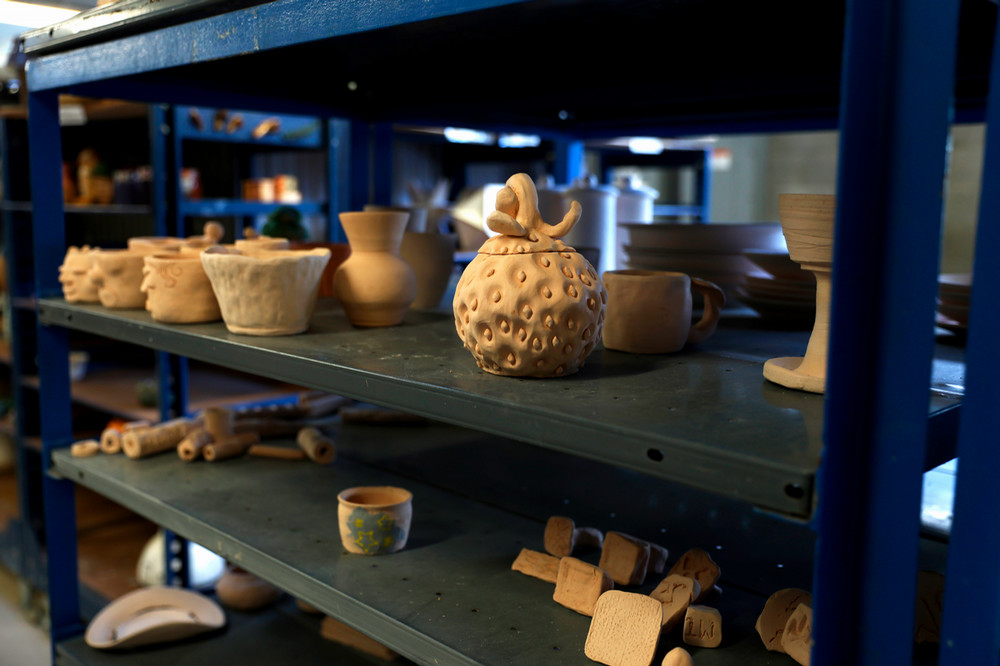
unglazed ceramic pieces on shelves

Visual Arts & Design

Bring your artistic vision to life with Butte College’s Visual Arts programs. Whether you’re drawn to painting, ceramics, photography, or graphic design, our courses provide the foundation and inspiration to develop your creative talent and explore career opportunities in the arts.

Programs

Program Name
Goal
Length
Flexibility
AA-T AS AA

Goal

Career or Transfer

Length

2 years

Flexibility

  • Main Campus
AA-T

Associate Degree for Transfer in Studio Arts

The Associate in Arts in Studio Arts for Transfer degree (AA-T in Studio Arts) provides a clear pathway for students planning to complete a Bachelor of Arts in Studio Arts at a California State University. This program offers students foundational knowledge and skills that reflect the core content of the first two years of many four-year Studio Arts programs. Students completing Associate Degrees for Transfer are guaranteed admission to the CSU system, though not to a particular campus or major.

AA

Associate Degree in Arts

Upon completion of the Associate Degree in Arts, students will be able to apply technical skills, creativity, critical thinking, and conceptual problem-solving to complete independent projects in visual art, design, and art history. They will analyze, compare, and synthesize significant global ideas and original works of art and architecture from diverse cultures and time periods. Students will produce, present, and describe a portfolio of original artworks and/or written analyses that reflect their artistic and academic growth.

AA

Associate Degree in Graphic Design

In the Graphic Design program, students receive hands-on training in many areas of the visual communications field. Butte College provides a complete design and computer lab to support the development of job-related skills and techniques. Many instructors are working professionals who bring current industry knowledge and awareness of future trends directly into the classroom. The program is designed to prepare students for entry-level positions in graphic design, while also providing a solid foundation for transfer to a four-year design school.

AS

Associate Degree in Graphic Design for Print

In the Graphic Design program, students receive hands-on training in many areas of the visual communications field. Butte College provides a complete design and computer lab to support the development of job-related skills and techniques. Many instructors are working professionals who bring current industry knowledge and awareness of future trends directly into the classroom. The program is designed to prepare students for entry-level positions in graphic design, while also providing a solid foundation for transfer to a four-year design school.

Flexibility

Across these programs, Main Campus is where you'll complete most required coursework, with the Chico Center reliably covering a solid portion that can help fill in your schedule. Online and Glenn Center are useful for general education but won't carry you through the major requirements on their own. The Graphic Design for Print program is a bit different — it requires splitting time between Main Campus and the Chico Center, since no single location covers the full major. Meet with a counselor to plan your term-by-term schedule.

How this flexibility note was generated

⚠ AI-generated content can be wrong. This note was produced by Claude (Anthropic) by synthesizing the individual program flexibility statements in this cluster. Verify against the per-program reports before relying on it.
You are synthesizing a single cluster-level flexibility statement for a community college academic cluster (a group of related programs that share a department-page accordion).

CLUSTER
  Title: Studio Art and Graphic Design
  Programs in cluster: 4

PER-PROGRAM STATEMENTS
  • Studio Arts (AA-T Degree):
      You can plan on Main Campus for your Studio Arts required coursework — it's reliably offered there. The Chico Center covers a good chunk of your requirements, but you'll need to fill in the rest at Main Campus, since Online only reliably covers a small piece and can't get you through the major on its own. If you're considering Dual Enrollment, keep in mind coverage varies a lot by high school. Check in with a counselor as you map out your schedule.
  • Arts (AA Degree):
      Main Campus is where you can plan to take your required Arts courses — all of them run reliably there. The Chico Center covers a good chunk of the major, so it could work as a partner location if you're combining schedules, but you'll still need Main Campus for the rest. Glenn Center and Online can help fill in general education, but they won't carry the required coursework, so check in with a counselor as you map out your schedule.
  • Graphic Design (AA Degree):
      For your Graphic Design AA, Main Campus reliably covers most of your required courses, so plan on being there for the bulk of your major coursework. The Chico Center offers some required courses reliably, which can fill in a few gaps, but it won't cover everything on its own. Online only reliably covers a couple of required slots, so don't count on finishing your major requirements that way, though GE breadth can be done there or at any center. Check in with a counselor to map out the exact sequence.
  • Graphic Design for Print (AS Degree):
      No single location covers all your required Graphic Design courses, so plan on splitting your time between Main Campus and the Chico Center, which together carry most of the major coursework. Glenn Center and Online only reliably cover a few required courses, so they're better for filling gaps or general education than for anchoring your schedule. Meet with a counselor to map out a term-by-term plan across these locations.

WHAT TO WRITE
  Write 2 to 3 sentences — under 120 words total — that summarize the AVAILABILITY STORY shared by these programs. Most programs in a cluster will have similar availability — name the common pattern. Note distinct outliers ONLY if a program's availability story differs in a way that affects student decisions (e.g., one program is online-only, others are not).

  - Plain, student-facing language.
  - Refer to "the programs in this cluster" or "these programs" — don't list each program by name unless an outlier needs calling out.
  - If all programs share the same flexibility story, write one unified statement.
  - Do NOT list percentages, term codes, or jargon.
  - Lead with the most flexible/strongest availability and follow with caveats.
  - Refer to locations ONLY by official center names (Main Campus, Chico Center, Glenn Center, Skyway Center, Cosmetology Center, Online). NEVER use a city or town name — no Oroville, no Willows, and never "Chico" as a city. Write "at the Chico Center", never "in Chico" — even if a per-program statement below used a city name, do not repeat it.

OUTPUT
  Return ONLY the statement text. No preamble, no quotation marks, no markdown.
AS AA CA

Goal

Career or Transfer

Length

1-2 years

Flexibility

  • Main Campus
AA CA

Associate Degree or Certificate of Achievement in Ceramics

The Ceramics program provides a strong foundation in both the technical and aesthetic aspects of the medium, with training in handbuilding, wheel throwing, clay and glaze chemistry, mold making, kiln operations, raku, and primitive firings. Students have access to a fully equipped studio, learn how to manage a ceramics facility, and develop professional portfolios. The program emphasizes ceramics as an art form while also exploring its connections to industry and business, and includes experience in exhibition installation. Students can earn the Certificate of Achievement in Ceramics in 1 year and the Associate Degree with further GE completion.

AS

Associate Degree in Photography

The Photography program provides students with a foundation in black-and-white and color photography, as well as the laboratory and technical skills required for entry-level employment. The curriculum prepares students to work as independent professional photographers or as technicians for others. Career opportunities are broad, with employment found in public relations, advertising, newspapers, magazines, fashion, portraiture, wedding, and scientific photography. Photographers are also employed by industrial and architectural firms, hospitals, schools, galleries, and government agencies, and are needed in areas such as aerial surveying and agricultural development.

Flexibility

Across this cluster, Main Campus is where you'll complete nearly all of your required coursework, since that's where classes run reliably term to term. The Chico Center offers a limited number of required courses for these programs, but not enough to build a full schedule around, so it works best paired with Main Campus rather than as a standalone option. Online, Dual Enrollment, and Glenn Center may help fill in a course here and there or cover general education, but they won't carry your major requirements — meet with a counselor to plan your specific sequence.

How this flexibility note was generated

⚠ AI-generated content can be wrong. This note was produced by Claude (Anthropic) by synthesizing the individual program flexibility statements in this cluster. Verify against the per-program reports before relying on it.
You are synthesizing a single cluster-level flexibility statement for a community college academic cluster (a group of related programs that share a department-page accordion).

CLUSTER
  Title: Photography and Ceramics
  Programs in cluster: 3

PER-PROGRAM STATEMENTS
  • Ceramics (AA Degree):
      For your Ceramics AA, you'll want to plan on being at Main Campus — that's where all of your required coursework reliably runs. The Chico Center offers a few required courses, but not enough to build your major schedule around, so it'll need to be paired with Main Campus. Online and Dual Enrollment cover only a small piece of the requirements, so they can't substitute for time on campus. Meet with a counselor to map out a schedule.
  • Ceramics (Certificate of Achievement):
      For this certificate, plan to be at Main Campus — all of your required Ceramics coursework runs reliably there. The Chico Center offers only a small piece of the required coursework, so it can't carry your major requirements on its own; you'd still need Main Campus for the rest. Online and Glenn Center work well for general education, but not for the Ceramics core. Check in with a counselor as you build your schedule, since offerings can shift.
  • Photography (AS Degree):
      You'll want to plan on being at Main Campus for nearly all of your required Photography courses — that's where the program reliably runs. The Chico Center and Online can fill in a course or two, but they won't cover your major requirements on their own, so don't count on finishing there. If your high school offers Dual Enrollment Photography courses, those can help too, though what's offered varies by school. Check in with a counselor to map out your specific sequence.

WHAT TO WRITE
  Write 2 to 3 sentences — under 120 words total — that summarize the AVAILABILITY STORY shared by these programs. Most programs in a cluster will have similar availability — name the common pattern. Note distinct outliers ONLY if a program's availability story differs in a way that affects student decisions (e.g., one program is online-only, others are not).

  - Plain, student-facing language.
  - Refer to "the programs in this cluster" or "these programs" — don't list each program by name unless an outlier needs calling out.
  - If all programs share the same flexibility story, write one unified statement.
  - Do NOT list percentages, term codes, or jargon.
  - Lead with the most flexible/strongest availability and follow with caveats.
  - Refer to locations ONLY by official center names (Main Campus, Chico Center, Glenn Center, Skyway Center, Cosmetology Center, Online). NEVER use a city or town name — no Oroville, no Willows, and never "Chico" as a city. Write "at the Chico Center", never "in Chico" — even if a per-program statement below used a city name, do not repeat it.

OUTPUT
  Return ONLY the statement text. No preamble, no quotation marks, no markdown.
AS CA

Goal

Career or Transfer

Length

1-2 years

Flexibility

  • Main Campus
AS CA

Associate Degree or Certificate of Achievement in Multimedia Studies

The Multimedia Studies program prepares students for today’s high-performance workplaces through a dynamic, project-based curriculum that emphasizes creativity, teamwork, and professionalism. Students gain hands-on experience in a state-of-the-art Macintosh-based New Media Lab using industry-standard multimedia applications while building skills in image design, sequencing, idea presentation, and portfolio development. Students can complete the 1-year Certificate of Achievement and continue additional GE to pursue an associate degree.

Flexibility

Both the AS degree and the certificate in this cluster require you to be at Main Campus, where the core Multimedia Studies coursework reliably runs. The Chico Center, Glenn Center, and Online can help cover general education classes, but they don't dependably offer the major coursework, so you can't complete either program through those locations alone. Meet with a counselor to plan your schedule, since course offerings can change over time.

How this flexibility note was generated

⚠ AI-generated content can be wrong. This note was produced by Claude (Anthropic) by synthesizing the individual program flexibility statements in this cluster. Verify against the per-program reports before relying on it.
You are synthesizing a single cluster-level flexibility statement for a community college academic cluster (a group of related programs that share a department-page accordion).

CLUSTER
  Title: Multimedia Studies
  Programs in cluster: 2

PER-PROGRAM STATEMENTS
  • Multimedia Studies (AS Degree):
      For your Multimedia Studies AS, plan to be at Main Campus for your required coursework — that's where it's been reliably offered. The Chico Center, Glenn Center, and Online can cover your general education classes, but not the major requirements, so relying on those locations alone won't get you through the program. Check in with a counselor to map out your schedule, since course offerings can shift over time.
  • Multimedia Studies (Certificate of Achievement):
      You'll want to plan on being at Main Campus for this certificate — that's where the required Multimedia Studies coursework reliably runs. The Chico Center, Glenn Center, and Online can help you knock out general education courses if your program includes them, but they don't currently offer the required major courses on a dependable basis, so you can't count on finishing the certificate there. Check in with a counselor as you build your schedule, since course offerings can shift over time.

WHAT TO WRITE
  Write 2 to 3 sentences — under 120 words total — that summarize the AVAILABILITY STORY shared by these programs. Most programs in a cluster will have similar availability — name the common pattern. Note distinct outliers ONLY if a program's availability story differs in a way that affects student decisions (e.g., one program is online-only, others are not).

  - Plain, student-facing language.
  - Refer to "the programs in this cluster" or "these programs" — don't list each program by name unless an outlier needs calling out.
  - If all programs share the same flexibility story, write one unified statement.
  - Do NOT list percentages, term codes, or jargon.
  - Lead with the most flexible/strongest availability and follow with caveats.
  - Refer to locations ONLY by official center names (Main Campus, Chico Center, Glenn Center, Skyway Center, Cosmetology Center, Online). NEVER use a city or town name — no Oroville, no Willows, and never "Chico" as a city. Write "at the Chico Center", never "in Chico" — even if a per-program statement below used a city name, do not repeat it.

OUTPUT
  Return ONLY the statement text. No preamble, no quotation marks, no markdown.
AA-T

Goal

Transfer

Length

2 years

Flexibility

AA-T

Associate Degree for Transfer in Art History

The Associate in Arts in Art History for Transfer degree (AA-T in Art History) provides a clear transfer pathway for students planning to pursue a Bachelor of Arts in Art History at a California State University. This program equips students with foundational knowledge and skills that reflect the core content of the first two years of many four-year Art History programs.

Flexibility

Main Campus is your best bet for this program, offering nearly all required coursework reliably, while the Chico Center and Online each cover only some classes and would need to be paired with Main Campus to complete the sequence. The Glenn Center doesn't offer required courses, though general education can be completed there. Dual enrollment options, if available at your high school, typically cover only a small piece of the major and vary by school, so meeting with a counselor to plan your sequence is recommended.

How this flexibility note was generated

⚠ AI-generated content can be wrong. This note was produced by Claude (Anthropic) by synthesizing the individual program flexibility statements in this cluster. Verify against the per-program reports before relying on it.
You are synthesizing a single cluster-level flexibility statement for a community college academic cluster (a group of related programs that share a department-page accordion).

CLUSTER
  Title: Art History
  Programs in cluster: 1

PER-PROGRAM STATEMENTS
  • Art History (AA-T Degree):
      For your Art History courses, Main Campus is your best bet — nearly all of your required coursework runs there reliably. The Chico Center and Online each cover only some of the required classes, so you'd need to combine either with Main Campus to fill the gaps, and the Glenn Center won't offer any of your required courses (though you can knock out general education there). If dual enrollment is available at your high school, keep in mind it typically covers just one piece of the major, and what's offered will vary by school. Meet with a counselor to map out the specific sequence.

WHAT TO WRITE
  Write 2 to 3 sentences — under 120 words total — that summarize the AVAILABILITY STORY shared by these programs. Most programs in a cluster will have similar availability — name the common pattern. Note distinct outliers ONLY if a program's availability story differs in a way that affects student decisions (e.g., one program is online-only, others are not).

  - Plain, student-facing language.
  - Refer to "the programs in this cluster" or "these programs" — don't list each program by name unless an outlier needs calling out.
  - If all programs share the same flexibility story, write one unified statement.
  - Do NOT list percentages, term codes, or jargon.
  - Lead with the most flexible/strongest availability and follow with caveats.
  - Refer to locations ONLY by official center names (Main Campus, Chico Center, Glenn Center, Skyway Center, Cosmetology Center, Online). NEVER use a city or town name — no Oroville, no Willows, and never "Chico" as a city. Write "at the Chico Center", never "in Chico" — even if a per-program statement below used a city name, do not repeat it.

OUTPUT
  Return ONLY the statement text. No preamble, no quotation marks, no markdown.
CC

Goal

Career

Length

1 semester

Flexibility

  • Main Campus
CC

Certificate of Completion in 2D Animation and Games

(Not Eligible for Financial Aid) The Certificate in 2D Animation and Games prepares students for entry-level positions in the rapidly growing gaming and animation industry by developing a multidisciplinary skill set that combines visual arts and coding for games. Students train in the Multimedia Studies program’s New Media Labs, which are equipped with state-of-the-art computers, software, and monitors, providing hands-on experience with the same tools used by professional animators and game designers today.

CC

Certificate of Completion in Professional Photography

(Not Eligible for Financial Aid) The Photography Certificate provides students with extensive training in both traditional and digital photography, developing a strong foundation in black-and-white and color processes, laboratory techniques, and digital workflows. Students gain expertise in image capture, enhancement, and output, including RAW-file workflow, digital printing, lighting techniques, and color management. The program emphasizes portfolio development through assignments, projects, and critiques.

Flexibility

Both programs in this cluster rely on a single home base for required coursework — the Chico Center for 2D Animation and Games, and Main Campus for Professional Photography — with no one location covering everything for the animation certificate. Glenn Center and Online mainly fill in general education needs rather than major requirements for either program, and Dual Enrollment may cover a course or two for animation depending on your high school. Meet with a counselor to plan the right combination of locations for your certificate.

How this flexibility note was generated

⚠ AI-generated content can be wrong. This note was produced by Claude (Anthropic) by synthesizing the individual program flexibility statements in this cluster. Verify against the per-program reports before relying on it.
You are synthesizing a single cluster-level flexibility statement for a community college academic cluster (a group of related programs that share a department-page accordion).

CLUSTER
  Title: Skill Builders
  Programs in cluster: 2

PER-PROGRAM STATEMENTS
  • 2D Animation and Games (Certificate):
      For this certificate, no single location has you fully covered — the Chico Center offers the most consistent required coursework, but you'll still need to fill in gaps elsewhere. Main Campus, Glenn Center, and Online only reliably offer general education courses for this program, not the major coursework itself. If your high school participates in Dual Enrollment, a required course or two may be available there, but offerings vary by school. Meet with a counselor to map out a realistic combination of locations for the required courses.
  • Professional Photography (Certificate):
      Plan on being at Main Campus for this certificate — all of your required photography coursework is reliably offered there. The Chico Center covers some of the required courses, but not all, so relying on it alone will leave gaps you'd need to fill at Main Campus. Glenn Center and Online can help with general education, but not with the certificate's required courses; check in with a counselor as you build your schedule.

WHAT TO WRITE
  Write 2 to 3 sentences — under 120 words total — that summarize the AVAILABILITY STORY shared by these programs. Most programs in a cluster will have similar availability — name the common pattern. Note distinct outliers ONLY if a program's availability story differs in a way that affects student decisions (e.g., one program is online-only, others are not).

  - Plain, student-facing language.
  - Refer to "the programs in this cluster" or "these programs" — don't list each program by name unless an outlier needs calling out.
  - If all programs share the same flexibility story, write one unified statement.
  - Do NOT list percentages, term codes, or jargon.
  - Lead with the most flexible/strongest availability and follow with caveats.
  - Refer to locations ONLY by official center names (Main Campus, Chico Center, Glenn Center, Skyway Center, Cosmetology Center, Online). NEVER use a city or town name — no Oroville, no Willows, and never "Chico" as a city. Write "at the Chico Center", never "in Chico" — even if a per-program statement below used a city name, do not repeat it.

OUTPUT
  Return ONLY the statement text. No preamble, no quotation marks, no markdown.
Department Visual Arts & Design

Full Time Faculty

Steven Niedbala

Art Academic Instructor

Sara Smallhouse

Art Academic Instructor

Simone Senat

Painting and Drawing Instructor

Aja Mulford

MultiMedia Studies Program Instructor

Associate Faculty

Nancy Meyer

Art Academic Instructor

Fiona Chin

Art Academic Instructor

Cameron Kelly

Art Academic Instructor

Natasha Shoro

Art Academic Instructor

Gregory Byard

Ceramics Instructor

Deborah Jenkins

Art Academic Instructor

Kamphoune Syphengpheth

Art Academic Instructor

Casey Fay

MultiMedia Studies Program Instructor

Barbara Jones

Art Academic Instructor

David Ruiz

Painting and Drawing Instructor

Erin Wade

Graphic Design Instructor

Sam Muntifering

Sculpture Instructor

Elizabeth Mateson

Ceramics Instructor

Zen Du

Ceramics Instructor

Christopher Berg

Ceramics Instructor

Brian McNamara

Ceramics Instructor

John Baca

Art Academic Instructor

Ada Privratsky

Painting and Drawing Instructor

Teresa Givens

Graphic Design Instructor

Shane Milburn

MultiMedia Studies Program Instructor

Christian Davila

MultiMedia Studies Program Instructor

Regina Davis

MultiMedia Studies Program Instructor

Forest Wong

Art Academic Instructor

Kevin Trivedi

MultiMedia Studies Program Instructor

Cody Philbrook

MultiMedia Studies Program Instructor

Jenn Daly

Photography Instructor

Sean Peeler

Photography Instructor

Adria Davis

Photography Instructor

Donald Campbell

Photography Instructor

Cynthia Schildhauer

Painting and Drawing Instructor

Justin Amian

MultiMedia Studies Program Instructor - Unit

Department Contacts

Office: ARTS 224
Department phone: (530) 895-2404
Contact phone: (530) 895-2259

Looking For Something Else?

Other Departments in Business, Cosmetology, Arts & Design

Explore Other Communities of Interest

All Programs

Five Butte College graduates pose together in their caps and gowns.

Start Here Go Anywhere

Department Visual Arts & Design